



The 2026 Edition: Decoding the World’s Fastest Cars
The quest to conquer the century-old benchmark of automotive speed—the 300 mph barrier—has evolved from a fringe pursuit into a high-stakes technological arms race. In 2026, the conversation surrounding the world’s fastest cars is no longer just about brute horsepower; it is a complex narrative of advanced aerodynamics, sustainable hypercar engineering, and the relentless pursuit of the absolute physical limits of traction and thermodynamics.
For the past decade, the automotive industry has witnessed a seismic shift. Traditional V12 behemoths are increasingly being challenged, and in some cases surpassed, by hybrid and electric powertrains that leverage instant torque and sophisticated energy management systems. This evolution is not merely about speed; it reflects a broader industry pivot toward electrification, where performance and environmental responsibility must coexist. As we dissect the current landscape, it becomes clear that the title of “world’s fastest car” is a coveted trophy, fiercely contested by legacy manufacturers and disruptive newcomers alike.
This deep dive explores the pinnacle of automotive engineering, examining the specific metrics, technological innovations, and historical context that define the current generation of speed demons. We will move beyond superficial rankings to analyze the engineering philosophies that enable these machines to shatter conventional boundaries, while also considering the regulatory and practical limitations that govern their real-world performance.
The Metrics That Matter: Defining “Fastest”
Before cataloging the contenders, it is crucial to understand the metrics that differentiate these hypercars. The term “fastest” is often used interchangeably with “top speed,” but the automotive world employs several precise metrics to quantify performance, each telling a different story about a car’s capabilities.
 Top Speed (Vmax): This is the ultimate benchmark, representing the maximum velocity a car can achieve under ideal conditions. It is a pure measure of aerodynamic efficiency and powertrain output. However, achieving a verified top speed is notoriously difficult. It requires not only a powerful engine but also a long, flat, and often private stretch of road, as public infrastructure rarely offers the necessary distance to safely reach such velocities. Furthermore, manufacturers must contend with safety systems and tire ratings that often limit the electronically governed speed.
Zero to 60 mph (0–96 km/h): This acceleration metric has become the standard for measuring a car’s initial responsiveness and launch capability. It is a critical figure for consumer marketing and racetrack performance, where quick acceleration off the line is paramount.
Quarter Mile (402 m): The quarter-mile time measures a car’s ability to accelerate over a standard drag racing distance. It combines initial launch with sustained acceleration, providing a comprehensive view of a vehicle’s straight-line performance.
Lateral G-Force: This metric measures a car’s cornering ability, indicating how much force a driver experiences when navigating turns. It is a crucial factor in determining a car’s overall handling prowess and racetrack performance.
In the context of the world’s fastest cars, top speed remains the ultimate arbiter. It is the metric that captures the imagination and represents the pinnacle of automotive engineering. However, the other metrics provide valuable context, revealing the broader capabilities of these incredible machines.
The Contenders: A Comprehensive Overview
The 2026 landscape is dominated by a select group of manufacturers who have dedicated decades to perfecting the art of high-speed automotive design. These companies operate at the bleeding edge of engineering, pushing the boundaries of what is physically possible.
Koenigsegg Jesko Absolut: The Swedish manufacturer Koenigsegg has long been a dominant force in the top-speed arena. The Jesko Absolut represents the culmination of Christian von Koenigsegg’s decades-long pursuit of the ultimate hypercar. Powered by a twin-supercharged 5.0-liter V8 engine, the Jesko Absolut produces a staggering 1,600 horsepower on E85 fuel. Its theoretical top speed is estimated to exceed 330 mph (531 km/h), though achieving this would require a runway longer than the world’s longest commercial airport runways.
The Jesko Absolut’s design is a masterclass in aerodynamic optimization. Its smooth, teardrop shape, virtual lack of a rear wing, and extended rear bodywork reduce drag to an unprecedented level. The car’s 9-speed multi-clutch transmission (LST) is a marvel of engineering, allowing for lightning-fast gear changes and ensuring that the engine stays within its optimal power band at all times. This combination of raw power and aerodynamic efficiency makes the Jesko Absolut the leading contender for the title of the world’s fastest car.
Bugatti Chiron Super Sport 300+: Bugatti, the French manufacturer synonymous with luxury and speed, shattered the 300 mph barrier in 2019 with the Chiron Super Sport 300+. While this was a one-way run and not officially recognized as a world record due to the car’s production nature and a one-way direction, it remains a monumental achievement in automotive history. The car’s quad-turbocharged 8.0-liter W16 engine produces 1,578 horsepower, enabling it to reach speeds in excess of 304 mph (490 km/h).
The Super Sport 300+ features an extended rear bodywork, reminiscent of the iconic Bugatti Type 57 SC Atlantic, to reduce drag and improve stability at extreme speeds. The car’s lightweight carbon fiber construction and advanced suspension systems ensure that it remains composed and controllable even at velocities that would be terrifying in lesser vehicles.
Top Speed (Vmax): This is the ultimate benchmark, representing the maximum velocity a car can achieve under ideal conditions. It is a pure measure of aerodynamic efficiency and powertrain output. However, achieving a verified top speed is notoriously difficult. It requires not only a powerful engine but also a long, flat, and often private stretch of road, as public infrastructure rarely offers the necessary distance to safely reach such velocities. Furthermore, manufacturers must contend with safety systems and tire ratings that often limit the electronically governed speed.
Zero to 60 mph (0–96 km/h): This acceleration metric has become the standard for measuring a car’s initial responsiveness and launch capability. It is a critical figure for consumer marketing and racetrack performance, where quick acceleration off the line is paramount.
Quarter Mile (402 m): The quarter-mile time measures a car’s ability to accelerate over a standard drag racing distance. It combines initial launch with sustained acceleration, providing a comprehensive view of a vehicle’s straight-line performance.
Lateral G-Force: This metric measures a car’s cornering ability, indicating how much force a driver experiences when navigating turns. It is a crucial factor in determining a car’s overall handling prowess and racetrack performance.
In the context of the world’s fastest cars, top speed remains the ultimate arbiter. It is the metric that captures the imagination and represents the pinnacle of automotive engineering. However, the other metrics provide valuable context, revealing the broader capabilities of these incredible machines.
The Contenders: A Comprehensive Overview
The 2026 landscape is dominated by a select group of manufacturers who have dedicated decades to perfecting the art of high-speed automotive design. These companies operate at the bleeding edge of engineering, pushing the boundaries of what is physically possible.
Koenigsegg Jesko Absolut: The Swedish manufacturer Koenigsegg has long been a dominant force in the top-speed arena. The Jesko Absolut represents the culmination of Christian von Koenigsegg’s decades-long pursuit of the ultimate hypercar. Powered by a twin-supercharged 5.0-liter V8 engine, the Jesko Absolut produces a staggering 1,600 horsepower on E85 fuel. Its theoretical top speed is estimated to exceed 330 mph (531 km/h), though achieving this would require a runway longer than the world’s longest commercial airport runways.
The Jesko Absolut’s design is a masterclass in aerodynamic optimization. Its smooth, teardrop shape, virtual lack of a rear wing, and extended rear bodywork reduce drag to an unprecedented level. The car’s 9-speed multi-clutch transmission (LST) is a marvel of engineering, allowing for lightning-fast gear changes and ensuring that the engine stays within its optimal power band at all times. This combination of raw power and aerodynamic efficiency makes the Jesko Absolut the leading contender for the title of the world’s fastest car.
Bugatti Chiron Super Sport 300+: Bugatti, the French manufacturer synonymous with luxury and speed, shattered the 300 mph barrier in 2019 with the Chiron Super Sport 300+. While this was a one-way run and not officially recognized as a world record due to the car’s production nature and a one-way direction, it remains a monumental achievement in automotive history. The car’s quad-turbocharged 8.0-liter W16 engine produces 1,578 horsepower, enabling it to reach speeds in excess of 304 mph (490 km/h).
The Super Sport 300+ features an extended rear bodywork, reminiscent of the iconic Bugatti Type 57 SC Atlantic, to reduce drag and improve stability at extreme speeds. The car’s lightweight carbon fiber construction and advanced suspension systems ensure that it remains composed and controllable even at velocities that would be terrifying in lesser vehicles.
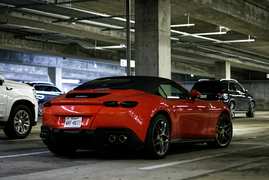 Hennessey Venom F5: Texas-based Hennessey Performance Engineering has emerged as a formidable challenger in the hypercar space. The Venom F5 is a purpose-built speed machine designed to break the 300 mph barrier. Powered by a twin-turbocharged 6.6-liter V8 engine, the F5 produces an astonishing 1,817 horsepower. Its lightweight carbon fiber chassis and slippery aerodynamic design contribute to its incredible performance.
Hennessey has conducted rigorous testing of the Venom F5, with drivers achieving speeds in excess of 270 mph (435 km/h) during development runs. The company remains confident that the F5 has the potential to exceed 300 mph, though it awaits the right conditions and location to conduct a verified top-speed attempt. The F5’s aggressive styling and raw power make it a true standout in the hypercar market.
SSC Tuatara: The SSC Tuatara, developed by American manufacturer SSC (formerly Shelby Super Cars), has been at the center of several high-profile top-speed attempts. The car is powered by a twin-turbocharged 5.9-liter V8 engine that produces 1,750 horsepower on E85 fuel. The Tuatara’s design features an elongated tail and active aerodynamic elements to minimize drag and maximize stability.
The Tuatara has been the subject of much debate regarding its top-speed claims. Following an initial attempt in 2020 that was plagued by controversy and ultimately acknowledged as not meeting record standards, SSC conducted a verified top-speed run in January 2021, achieving a two-way average of 282.9 mph (455.3 km/h). While this is an incredible speed, it falls short of the company’s ultimate goal. SSC continues to refine the Tuatara, aiming to achieve a verified top speed that will cement its place among the fastest cars in the world.
Koenigsegg Agera RS: The predecessor to the Jesko Absolut, the Koenigsegg Agera RS held the official Guinness World Record for the fastest production car for several years. In 2017, the Agera RS achieved a two-way average speed of 277.9 mph (447.2 km/h) on a closed highway in Nevada. This record remains a benchmark in the industry, demonstrating the remarkable capabilities of Koenigsegg’s engineering.
The Agera RS is powered by a 5.0-liter twin-turbocharged V8 engine that produces 1,360 horsepower. Its advanced aerodynamic package includes active spoilers and flaps that optimize downforce and stability at high speeds. The car’s lightweight carbon fiber construction and precision-engineered chassis make it a formidable performer on both the track and the open road.
McLaren Speedtail: McLaren’s entry into the top-speed arena is the Speedtail, a spiritual successor to the legendary McLaren F1. The Speedtail is a hybrid hypercar that combines a twin-turbocharged 4.0-liter V8 engine with an electric motor, producing a combined output of 1,036 horsepower. Its most striking feature is its unique three-seat configuration, with the driver positioned in the center, inspired by the F1.
The Speedtail’s design is focused on aerodynamic efficiency, with a long, tapering tail and active aero elements that optimize airflow. The car’s top speed is electronically limited to 250 mph (402 km/h), though testing has shown it capable of exceeding this figure. The Speedtail represents McLaren’s commitment to combining extreme performance with luxury and technological innovation.
The Electric Revolution: A New Frontier
While the traditional gasoline-powered hypercars continue to push the boundaries of speed, the automotive world is rapidly embracing electrification. The instant torque and rapid acceleration of electric powertrains are proving to be a formidable force in the quest for ultimate performance.
Hennessey Venom F5: Texas-based Hennessey Performance Engineering has emerged as a formidable challenger in the hypercar space. The Venom F5 is a purpose-built speed machine designed to break the 300 mph barrier. Powered by a twin-turbocharged 6.6-liter V8 engine, the F5 produces an astonishing 1,817 horsepower. Its lightweight carbon fiber chassis and slippery aerodynamic design contribute to its incredible performance.
Hennessey has conducted rigorous testing of the Venom F5, with drivers achieving speeds in excess of 270 mph (435 km/h) during development runs. The company remains confident that the F5 has the potential to exceed 300 mph, though it awaits the right conditions and location to conduct a verified top-speed attempt. The F5’s aggressive styling and raw power make it a true standout in the hypercar market.
SSC Tuatara: The SSC Tuatara, developed by American manufacturer SSC (formerly Shelby Super Cars), has been at the center of several high-profile top-speed attempts. The car is powered by a twin-turbocharged 5.9-liter V8 engine that produces 1,750 horsepower on E85 fuel. The Tuatara’s design features an elongated tail and active aerodynamic elements to minimize drag and maximize stability.
The Tuatara has been the subject of much debate regarding its top-speed claims. Following an initial attempt in 2020 that was plagued by controversy and ultimately acknowledged as not meeting record standards, SSC conducted a verified top-speed run in January 2021, achieving a two-way average of 282.9 mph (455.3 km/h). While this is an incredible speed, it falls short of the company’s ultimate goal. SSC continues to refine the Tuatara, aiming to achieve a verified top speed that will cement its place among the fastest cars in the world.
Koenigsegg Agera RS: The predecessor to the Jesko Absolut, the Koenigsegg Agera RS held the official Guinness World Record for the fastest production car for several years. In 2017, the Agera RS achieved a two-way average speed of 277.9 mph (447.2 km/h) on a closed highway in Nevada. This record remains a benchmark in the industry, demonstrating the remarkable capabilities of Koenigsegg’s engineering.
The Agera RS is powered by a 5.0-liter twin-turbocharged V8 engine that produces 1,360 horsepower. Its advanced aerodynamic package includes active spoilers and flaps that optimize downforce and stability at high speeds. The car’s lightweight carbon fiber construction and precision-engineered chassis make it a formidable performer on both the track and the open road.
McLaren Speedtail: McLaren’s entry into the top-speed arena is the Speedtail, a spiritual successor to the legendary McLaren F1. The Speedtail is a hybrid hypercar that combines a twin-turbocharged 4.0-liter V8 engine with an electric motor, producing a combined output of 1,036 horsepower. Its most striking feature is its unique three-seat configuration, with the driver positioned in the center, inspired by the F1.
The Speedtail’s design is focused on aerodynamic efficiency, with a long, tapering tail and active aero elements that optimize airflow. The car’s top speed is electronically limited to 250 mph (402 km/h), though testing has shown it capable of exceeding this figure. The Speedtail represents McLaren’s commitment to combining extreme performance with luxury and technological innovation.
The Electric Revolution: A New Frontier
While the traditional gasoline-powered hypercars continue to push the boundaries of speed, the automotive world is rapidly embracing electrification. The instant torque and rapid acceleration of electric powertrains are proving to be a formidable force in the quest for ultimate performance.
 Rimac Nevera: Croatian manufacturer Rimac Automobili has emerged as a leader in the electric hypercar space. The Nevera is a fully electric vehicle that produces a staggering 1,914 horsepower from its four electric