



The Evolution of Hypercars: A Deep Dive into the Top 10 Fastest Cars in the World in 2026
The quest for ultimate velocity has always been the defining frontier of automotive engineering. For decades, the speedometer needle has served as the ultimate bragging right, pushing engineers and designers to the very brink of what’s physically possible. In 2026, the landscape of hypercars has reached a level of sophistication and raw power that was once relegated to science fiction. This isn’t just about getting from A to B faster; it’s a testament to human ingenuity, aerodynamic mastery, and the relentless pursuit of the unattainable.
For industry veterans like myself, who have witnessed the transition from the mechanical marvels of the 20th century to the electrified beasts of today, this era represents a paradigm shift. We’re seeing a fascinating convergence of traditional internal combustion engines (ICE) with cutting-edge electric propulsion systems. This hybrid approach is unlocking levels of performance that shatter previous benchmarks, making the quest for the title of the fastest car in the world more competitive and exhilarating than ever before.
The metrics of automotive excellence have evolved. While horsepower remains a critical figure, the true measure of a modern hypercar lies in its holistic engineering. It’s about the seamless integration of power delivery, aerodynamic efficiency, weight management, and increasingly, sustainable materials. The top 10 fastest cars in the world list for 2026 tells a story of global competition, with European titans clashing against American disruptors and boutique manufacturers pushing the boundaries of what’s possible.
The Science of Speed: What Makes a Hypercar a Hypercar?
Before diving into the specific models that dominate the 2026 rankings, it’s crucial to understand the science that underpins their phenomenal capabilities. Achieving speeds exceeding 300 mph requires a perfect storm of engineering prowess.
Aerodynamics: The Unseen Force
At these velocities, air resistance becomes a formidable foe, capable of ripping conventional vehicles apart. The most successful hypercars employ active aerodynamic systems that adapt to changing conditions. Front splitters, adjustable rear wings, and underbody diffusers work in concert to generate massive downforce, pressing the car into the tarmac for maximum grip. However, this downforce must be carefully managed. Too much, and the car becomes drag-limited; too little, and stability is compromised. The fastest cars in the world strike this delicate balance with near-surgical precision.
 Powertrain Innovation: ICE vs. Electric
The 2026 landscape is characterized by a fascinating powertrain dichotomy. On one hand, we have the refinement of the internal combustion engine. Manufacturers like Bugatti and Koenigsegg have pushed the W16 and V8 configurations to their absolute limits, achieving unprecedented power outputs through advanced materials and forced induction. These engines offer a visceral driving experience, complete with the mechanical symphony that petrolheads crave.
On the other hand, electric hypercars are rapidly ascending the ranks. With instant torque delivery and the ability to scale power outputs exponentially, EVs offer a compelling case for ultimate speed. The challenge here lies in battery technology—specifically, energy density and thermal management. A car that can accelerate ferociously is useless if its battery overheats after a single run. The fastest production cars in 2026 are those that have cracked this code, offering sustainable speed without compromise.
Materials Science: The Quest for Lightness
Weight is the enemy of speed. Every kilogram shed improves acceleration, braking, and handling. The leading hypercars of 2026 are constructed almost entirely from carbon fiber composites, titanium, and advanced alloys. This obsessive focus on weight reduction allows manufacturers to maximize the potential of their powertrains, creating machines that feel as agile as they are powerful.
The Contenders: A Look at the 2026 Top 10
The 2026 list of the fastest cars in the world is a testament to the globalization of the automotive industry. While established European giants continue to dominate the high-performance segment, American and Asian manufacturers are making significant inroads, challenging the status quo with innovative engineering and audacious performance targets.
The Reigning Monarch: Koenigsegg Jesko Absolut
The Swedish marque Koenigsegg has long been synonymous with pushing the boundaries of speed. The Jesko Absolut, named after the founder’s father, is the culmination of years of relentless engineering. Devoid of a hybrid system, this rear-wheel-drive monster relies on a twin-turbocharged 5.0-liter flat-plane V8 that produces a staggering 1,600 horsepower on E85 biofuel.
What sets the Jesko Absolut apart is its revolutionary aerodynamics. The “low-drag” bodywork is a masterclass in air management, featuring a design that minimizes frontal area and optimizes airflow. The manufacturer claims a theoretical top speed of over 330 mph, though achieving this in the real world remains a challenge due to tire limitations and road availability. For many in the industry, the Jesko Absolut represents the current pinnacle of ICE-powered speed.
The American Disruptor: Hennessey Venom F5 Revolution
American tuner Hennessey Performance Engineering has carved a niche for itself by building some of the most extreme road-legal machines on the planet. The Venom F5 Revolution is a track-focused evolution of their already formidable Venom F5. Powered by a 6.6-liter twin-turbocharged V8 known as “Fury,” it produces a mind-bending 1,817 horsepower.
The “Revolution” moniker signifies a complete aerodynamic overhaul, featuring a massive rear wing, aggressive dive planes, and a vented hood that channels air with surgical precision. Hennessey’s target is clear: to break the 300 mph barrier conclusively and reclaim the title of the fastest production car. The Venom F5’s raw, unfiltered power delivery offers a visceral experience that few modern vehicles can match.
The Electric Challenger: Rimac Nevera
Powertrain Innovation: ICE vs. Electric
The 2026 landscape is characterized by a fascinating powertrain dichotomy. On one hand, we have the refinement of the internal combustion engine. Manufacturers like Bugatti and Koenigsegg have pushed the W16 and V8 configurations to their absolute limits, achieving unprecedented power outputs through advanced materials and forced induction. These engines offer a visceral driving experience, complete with the mechanical symphony that petrolheads crave.
On the other hand, electric hypercars are rapidly ascending the ranks. With instant torque delivery and the ability to scale power outputs exponentially, EVs offer a compelling case for ultimate speed. The challenge here lies in battery technology—specifically, energy density and thermal management. A car that can accelerate ferociously is useless if its battery overheats after a single run. The fastest production cars in 2026 are those that have cracked this code, offering sustainable speed without compromise.
Materials Science: The Quest for Lightness
Weight is the enemy of speed. Every kilogram shed improves acceleration, braking, and handling. The leading hypercars of 2026 are constructed almost entirely from carbon fiber composites, titanium, and advanced alloys. This obsessive focus on weight reduction allows manufacturers to maximize the potential of their powertrains, creating machines that feel as agile as they are powerful.
The Contenders: A Look at the 2026 Top 10
The 2026 list of the fastest cars in the world is a testament to the globalization of the automotive industry. While established European giants continue to dominate the high-performance segment, American and Asian manufacturers are making significant inroads, challenging the status quo with innovative engineering and audacious performance targets.
The Reigning Monarch: Koenigsegg Jesko Absolut
The Swedish marque Koenigsegg has long been synonymous with pushing the boundaries of speed. The Jesko Absolut, named after the founder’s father, is the culmination of years of relentless engineering. Devoid of a hybrid system, this rear-wheel-drive monster relies on a twin-turbocharged 5.0-liter flat-plane V8 that produces a staggering 1,600 horsepower on E85 biofuel.
What sets the Jesko Absolut apart is its revolutionary aerodynamics. The “low-drag” bodywork is a masterclass in air management, featuring a design that minimizes frontal area and optimizes airflow. The manufacturer claims a theoretical top speed of over 330 mph, though achieving this in the real world remains a challenge due to tire limitations and road availability. For many in the industry, the Jesko Absolut represents the current pinnacle of ICE-powered speed.
The American Disruptor: Hennessey Venom F5 Revolution
American tuner Hennessey Performance Engineering has carved a niche for itself by building some of the most extreme road-legal machines on the planet. The Venom F5 Revolution is a track-focused evolution of their already formidable Venom F5. Powered by a 6.6-liter twin-turbocharged V8 known as “Fury,” it produces a mind-bending 1,817 horsepower.
The “Revolution” moniker signifies a complete aerodynamic overhaul, featuring a massive rear wing, aggressive dive planes, and a vented hood that channels air with surgical precision. Hennessey’s target is clear: to break the 300 mph barrier conclusively and reclaim the title of the fastest production car. The Venom F5’s raw, unfiltered power delivery offers a visceral experience that few modern vehicles can match.
The Electric Challenger: Rimac Nevera
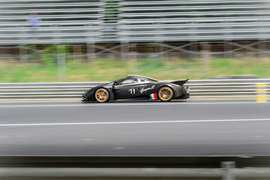 The Croatian newcomer Rimac Automobili has redefined what’s possible with electric propulsion. The Nevera is not just an electric car; it’s a technological tour de force. With four independent electric motors, one for each wheel, the Nevera boasts a combined output of 1,914 horsepower and 2,360 Nm of torque.
What makes the Nevera truly special is its all-wheel-drive torque vectoring system, which can distribute power to individual wheels with millisecond precision. This allows for unprecedented agility and stability, even at extreme speeds. The Nevera has already set numerous records, including the 0-60 mph sprint (under 2 seconds) and the quarter-mile. Its ability to combine blistering straight-line speed with track-capable handling makes it a benchmark for the fastest electric hypercars.
The Hybrid Icon: Bugatti Chiron Super Sport 300+
While Bugatti has shifted its focus toward the hybrid era, the legacy of the Chiron Super Sport 300+ remains etched in automotive history. This limited-edition model was the first production car to officially break the 300 mph barrier, albeit in a one-way run. Powered by Bugatti’s iconic quad-turbocharged W16 engine, the Super Sport 300+ produces 1,600 horsepower.
The “longtail” bodywork is a testament to aerodynamic optimization, reducing drag and enhancing stability at speeds exceeding 270 mph. While Bugatti has since moved on to hybrid successors, the Super Sport 300+ remains a symbol of the company’s engineering prowess and their relentless pursuit of speed. Its place on the fastest cars in the world list is well-deserved, representing the pinnacle of ICE hypercar engineering.
The Undisputed King of Speed: SSC Tuatara
The SSC Tuatara has had a tumultuous journey in its quest for the top speed record. After an initial run was invalidated due to measurement inconsistencies, the American manufacturer returned with renewed determination. The Tuatara features a 5.9-liter twin-turbocharged V8 producing 1,750 horsepower, paired with an advanced aerodynamic package designed to minimize drag.
In 2025, the Tuatara achieved a verified two-way average speed of 295 mph, with a top speed of 316 mph on one pass. While this fell short of the mythical 300 mph mark on both runs, it remains one of the fastest production cars ever built. The Tuatara’s story highlights the extreme difficulty of setting these records—it requires the perfect alignment of vehicle capability, driver skill, and road conditions.
The Rising Stars: Innovations Shaping the Future of Speed
The 2026 list isn’t just about the established players. We’re witnessing the rise of new manufacturers and technologies that are challenging the traditional automotive hierarchy.
The Aspark Owl: Japan’s Electric Contender
Japanese manufacturer Aspark has entered the fray with the Owl, an all-electric hypercar that boasts blistering performance figures. With four electric motors producing a combined 1,950 horsepower, the Owl can accelerate from 0 to 60 mph in a scarcely believable 1.69 seconds. Its low-slung, aerodynamic design emphasizes its electric nature, with a focus on minimizing drag to maximize range and top speed.
The Lotus Evija: British Elegance Meets Electric Power
The Croatian newcomer Rimac Automobili has redefined what’s possible with electric propulsion. The Nevera is not just an electric car; it’s a technological tour de force. With four independent electric motors, one for each wheel, the Nevera boasts a combined output of 1,914 horsepower and 2,360 Nm of torque.
What makes the Nevera truly special is its all-wheel-drive torque vectoring system, which can distribute power to individual wheels with millisecond precision. This allows for unprecedented agility and stability, even at extreme speeds. The Nevera has already set numerous records, including the 0-60 mph sprint (under 2 seconds) and the quarter-mile. Its ability to combine blistering straight-line speed with track-capable handling makes it a benchmark for the fastest electric hypercars.
The Hybrid Icon: Bugatti Chiron Super Sport 300+
While Bugatti has shifted its focus toward the hybrid era, the legacy of the Chiron Super Sport 300+ remains etched in automotive history. This limited-edition model was the first production car to officially break the 300 mph barrier, albeit in a one-way run. Powered by Bugatti’s iconic quad-turbocharged W16 engine, the Super Sport 300+ produces 1,600 horsepower.
The “longtail” bodywork is a testament to aerodynamic optimization, reducing drag and enhancing stability at speeds exceeding 270 mph. While Bugatti has since moved on to hybrid successors, the Super Sport 300+ remains a symbol of the company’s engineering prowess and their relentless pursuit of speed. Its place on the fastest cars in the world list is well-deserved, representing the pinnacle of ICE hypercar engineering.
The Undisputed King of Speed: SSC Tuatara
The SSC Tuatara has had a tumultuous journey in its quest for the top speed record. After an initial run was invalidated due to measurement inconsistencies, the American manufacturer returned with renewed determination. The Tuatara features a 5.9-liter twin-turbocharged V8 producing 1,750 horsepower, paired with an advanced aerodynamic package designed to minimize drag.
In 2025, the Tuatara achieved a verified two-way average speed of 295 mph, with a top speed of 316 mph on one pass. While this fell short of the mythical 300 mph mark on both runs, it remains one of the fastest production cars ever built. The Tuatara’s story highlights the extreme difficulty of setting these records—it requires the perfect alignment of vehicle capability, driver skill, and road conditions.
The Rising Stars: Innovations Shaping the Future of Speed
The 2026 list isn’t just about the established players. We’re witnessing the rise of new manufacturers and technologies that are challenging the traditional automotive hierarchy.
The Aspark Owl: Japan’s Electric Contender
Japanese manufacturer Aspark has entered the fray with the Owl, an all-electric hypercar that boasts blistering performance figures. With four electric motors producing a combined 1,950 horsepower, the Owl can accelerate from 0 to 60 mph in a scarcely believable 1.69 seconds. Its low-slung, aerodynamic design emphasizes its electric nature, with a focus on minimizing drag to maximize range and top speed.
The Lotus Evija: British Elegance Meets Electric Power
 British marque Lotus, long known for its lightweight, driver-focused sports cars, has made a bold statement with the Evija. This all-